


This essay is Part Two of a revision of the pedagogical essay, “Writing Under the Bodhi Tree,” published in Academic Exchange Quarterly, Summer 2005.
In part one of this four-part essay series, I introduced Buddhist Philosophy as a fitting set of guidelines for civil discourse, specifically citing Thich Nhat Hanh’s “Charter of Interbeing” for supporting the importance of rhetoric, Kairos, and audience consideration, in general.
Four principles constitute Interbeing: nonattachment from views, direct experimentation, appropriateness, and skillful means. The first essay addressed “nonattachment from views.” This essay will address “direct experimentation” as a principle that can help us better understand the practice of successful civil discourse.
Direct Experimentation
Revising a text about the teaching of writing into one about the best practices of civil discourse was not a long leap. Both center on the theory and practice of rhetoric, but while the former focuses on writing to a considered yet deferred audience, the latter constitutes all communication but emphasizes oral monologue and dialogue as the most influential media within the marketplace of ideas. In the marketplace of ideas, direct experimentation is imperative.
In his book, Interbeing: The Fourteen Guidelines for Engaged Buddhism, Thich Nhat Hanh explains that “Buddhism emphasizes the direct experience of reality, not speculative philosophy. Direct-practice-realization, not intellectual research, brings about insight. Our own life is the instrument through which we experiment with truth.” Direct experimentation is about truly being in the here and now, truly interbeing, with others, whether one-on-one or as a speaker to an audience.
Rhetoric can be understood in two modes: Theory (rhetorica docens) and Practice (rhetorical utens). Though both modes are important, Hanh emphasizes that, ultimately, we must focus on the subject individual in front of us, not a theory about that individual. This, according to Hanh, brings about insight, or a realization of the best way to deal with a rhetorical situation like having a dialogue or giving a speech. Hanh sums up the importance of direct experimentation when he writes, “Our own life is the instrument through which we experiment with truth.” This statement puts the emphasis on human interaction over a-situational methodology.
And because the emphasis is on human interaction, the concept of direct experimentation brings us to the efficacy of active listening. Active listening is a bit more than what we typically think when we think about what it is to listen. Many people equate listening to hearing what someone says, plain and simple. However, active listening is more transparent. Where listening denotes hearing what is said, active listening denotes what is being said, why it is being said, and how it is being said. With active listening, one must listen with an earnest desire to understand what is being said, not just to respect the speaker, but to be better prepared to respond authentically. What’s more empathy is needed in both its affective and cognitive forms. To get one’s point across as clearly as possible, one would do well to know the “why” and “how “of an audience’s feelings and thoughts. This dance of speaking and listening is more indicative of collaboration. Notice I said “dance” and not “battle;” even debate becomes a form of teamwork of teamwork within an order of interbeing.
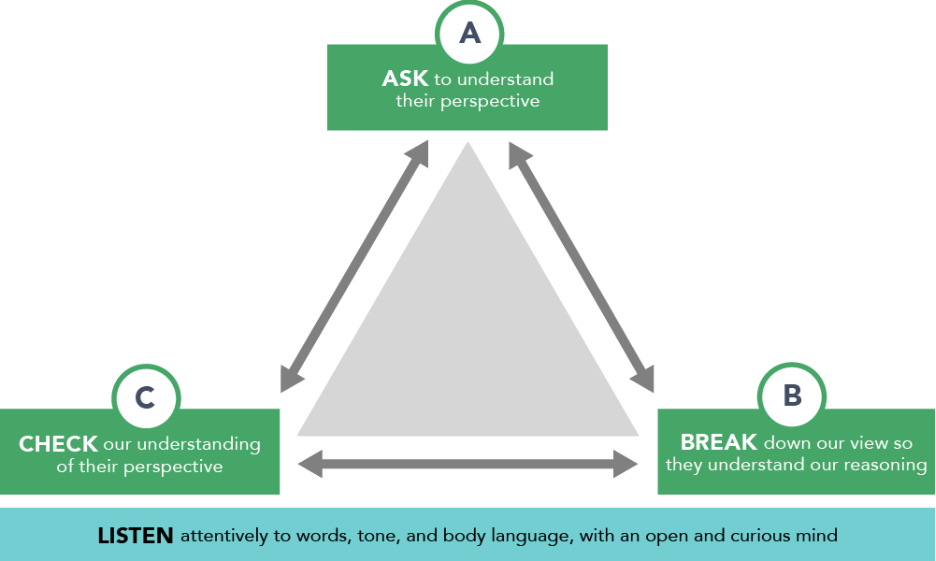
To emphasize rhetorica utens, specifically, we would do well to look to at least one heuristic. In “The Promise of Listening Rhetoric in 2024,” I wrote of Urban Rural Action, an organization geared toward “advancing peace, democracy, and justice through shared purpose: preventing organized violence in conflict zones.” The focus is on conversations that involve higher stakes regarding societal wellbeing.
To assist with active listening, Urban Rural Action put forth the “ABCs of Constructive Dialogue” rendered as A: active listening, B: breaking down one’s own view, and, perhaps most importantly, C: checking our understanding of the other’s viewpoint. Urban Rural Actions’ rationale reads:
When we view dialogue across difference as a competition, we tend to engage unconstructively, fueling frustration and damaging relationships.
When we view dialogue across difference as a collaboration opportunity, we engage more constructively, contributing to deeper understanding of different views and stronger relationships.
If this take on interpersonal relationships, even “across difference,” works for such a sensitive issue like targeted violence, it can work for civil discourse in general. (See this article for my elaboration on the ABCs of Constructive Dialogue.)
The concept of direct experimentation helps us stay grounded in our humanity and meet people where they are when trying to communicate effectively. The fact that it is a key principle for a spiritual concept of human coexistence should not be so surprising. Communication is part of the essence of being human. Let us strengthen our humanity by strengthening our communication.